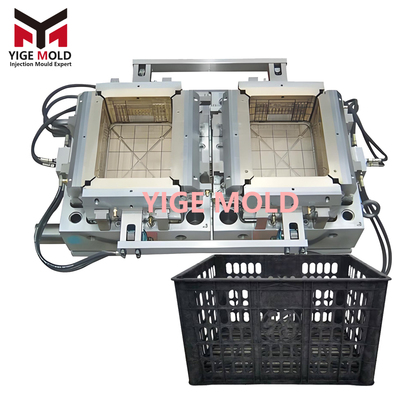
 The Great Reveal of Plastic Mold Lead Times: Why Does It Usually Take 30 to 60 Days?
In the plastic product development process, one of the most concerning and anxiety-inducing questions for many clients is: "How long will it actually take to get the mold?" When you take your drawings to get a quote, the answer is often "25 to 35 days" or even "45 to 60 days." Many people can't help but wonder: Isn't it just digging a pit into two blocks of iron? Why does it take so long? Can't it be done in a few days?
In reality, mold making is a systematic engineering feat that rigorously tests precision. From drawing to physical reality, a qualified plastic mold typically goes through a series of strict procedures. Today, let's break down what exactly the mold factory is busy with during this long "lead time."
The "Standard Answer" for Lead Time: 30 to 60 Days is the Norm
First, we need to set a reasonable expectation. In the mold industry, there is no absolutely fixed number of days for the lead time; it depends entirely on the product's structural complexity, size, and the precision requirements of the mold.
Simple Molds (e.g., daily necessities, simple housings): With a single structure and no complex sliders or lifters, the lead time is usually around 25 to 35 days.
Medium Complexity Molds (e.g., appliance housings, automotive interior parts): Involving multi-cavity designs or certain core-pulling mechanisms, the lead time is typically 45 to 60 days.
High-Precision or Ultra-Large Molds (e.g., medical devices, large bumpers): With extremely high requirements for precision and lifespan, the lead time can stretch to 90 days or even over half a year.
⚙️ Where Did the Time Go? Unveiling the Four Core Stages of Mold Manufacturing
Why does making a mold take dozens of days instead of just a few? Because mold manufacturing is an interlocking precision chain. Rushing any single step could lead to the scrapping of the final product.
1. Preliminary Analysis and Mold Design (Approx. 1-2 weeks)
Mold making doesn't start the moment the drawings arrive. Professional mold engineers must first conduct a DFM (Design for Manufacturability) analysis to check if your product design has any undercuts, uneven wall thickness, or ejection difficulties, and communicate optimization plans with you. Once confirmed, designers will use professional software to perform mold parting, designing internal structures like cooling systems, ejection systems, and runner systems. This step is the "soul" of the mold; if the design goes wrong, all subsequent machining will fail.
2. Material Procurement and Rough Machining (Approx. 3-5 days)
After the design drawing review is approved, the mold factory will procure the corresponding mold steels (such as P20, 718H, S136, etc.) based on the mold's lifespan requirements. If it's imported steel, procurement and shipping alone could take a couple of weeks. Once the steel arrives, it undergoes initial contour machining via sawing machines, milling machines, or CNC machines to remove excess material and form the mold blank.
3. Precision Machining and Heat Treatment (Approx. 2-4 weeks, the most critical stage)
This is the most time-consuming and costly part of the entire lead time. Various mold parts (such as cavities, cores, sliders, etc.) need to be machined to micron-level precision.
CNC Precision Machining and EDM (Electrical Discharge Machining): Carving out the complex structures and fine textures of the mold.
Heat Treatment: To improve the hardness and wear resistance of the mold, many steels require vacuum quenching and tempering. This process itself takes several days and must be strictly controlled to prevent deformation.
Wire Cutting and Drilling: Handling tiny holes and irregular structures within the mold.
4. Assembly, Trial, and Acceptance (Approx. 1-2 weeks)
After all parts are machined, experienced fitters will assemble guide pillars, ejector pins, cooling channels, and other components together, much like assembling a precision watch. Once assembled, the mold is mounted onto an injection molding machine for a "T1 Trial". The samples produced are inspected for dimensions and appearance. If there are issues like shrinkage, flash, or dimensional deviations, the mold needs to be sent back for local modifications until the samples are fully合格 (qualified).
How to Scientifically Shorten the Lead Time?
Although mold manufacturing has its objective physical laws, we can still effectively shorten the waiting time through scientific strategies:
Early DFM Involvement: Invite mold engineers to participate during the product design stage to avoid repeated mold modifications later due to unreasonable product structures, which is the biggest time-killer.
Adopt Concurrent Engineering: Before the design is fully complete, pre-order long-lead-time mold steels or standard mold bases to reduce material waiting time.
Choose Manufacturers with In-House Machining Capabilities: Manufacturers like Yige Mold, which possess complete in-house CNC, EDM machining, and trial capabilities, can better control production schedules and avoid communication costs and logistics delays caused by outsourced processing (such as external heat treatment or wire cutting).
Use Rapid Tooling Technology: If the goal is early market validation, you can opt for aluminum molds or soft molds, which can produce samples in as fast as 10 to 20 days. Although their lifespan is shorter, they can greatly help you seize the market initiative.
Mold making is a game of time and precision. Understanding the complex processes behind it might give you a bit more peace of mind while waiting for your mold delivery. After all, slow and steady wins the race—a durable, stable, and high-quality mold is absolutely worth these dozens of days of meticulous polishing.

 The Great Reveal of Plastic Mold Lead Times: Why Does It Usually Take 30 to 60 Days?